
Britain’s Missing Pumpkins
You’ll notice, on your next shop, that Halloween is less than 30 days away and there are no 2-4-1 supermarket enclosures filled to the brim with bright orange pumpkins of varying size and price. The best you’ll find is a fist-sized, pitiable, pencil holder of a pumpkin that you can’t even carve. The droughts this summer were utterly disgusting, a true inlet into the devastating effects extreme weather will continue to have on the sanity of the British psyche. Not only did the droughts leave half of London crunchy and yellow, but they also wiped out tens of thousands of pumpkins across the farms affected, while leaving others too stunted to grow big enough to even hack faces into. I feel Halloweimic!
Pumpkins are truly a staple of British Halloween culture. Whether we’re turning them into pies or something weirdly savoury, or creating jack-o-lanterns that look more horrific the mushier they get by December. Greta never (specifically) warned us that climate change could affect this holiday. I had just gotten used to not using plastic straws, the prolifically hot August months and slightly more tepid Septembers. But now, you’re telling me no more pumpkins? Start the boat, Thunberg. We’re sailing to the UN.
I visited M&S outside of Finsbury Park station on Friday 9 October and there were only five or six pumpkins on display (pictured), unappealingly layered in small, green baskets, one on top of the other, by the meal deal section. My online checks on Saturday 10 October told a similar story: while Sainsbury’s had some ordinary stock available, its giant variety was unavailable. Waitrose’s carving pumpkin and ghost-pumpkin listings read ‘Sorry, this item is not available’. These checks offer a snapshot of patchy availability, rather than a measure of stock across the country. The problem of size, however, is illuminated by a very ominous clarification on Ocado’s carving-pumpkin listing, which reads: ‘Due to seasonal growing conditions, this year’s crop is generally smaller than average’.
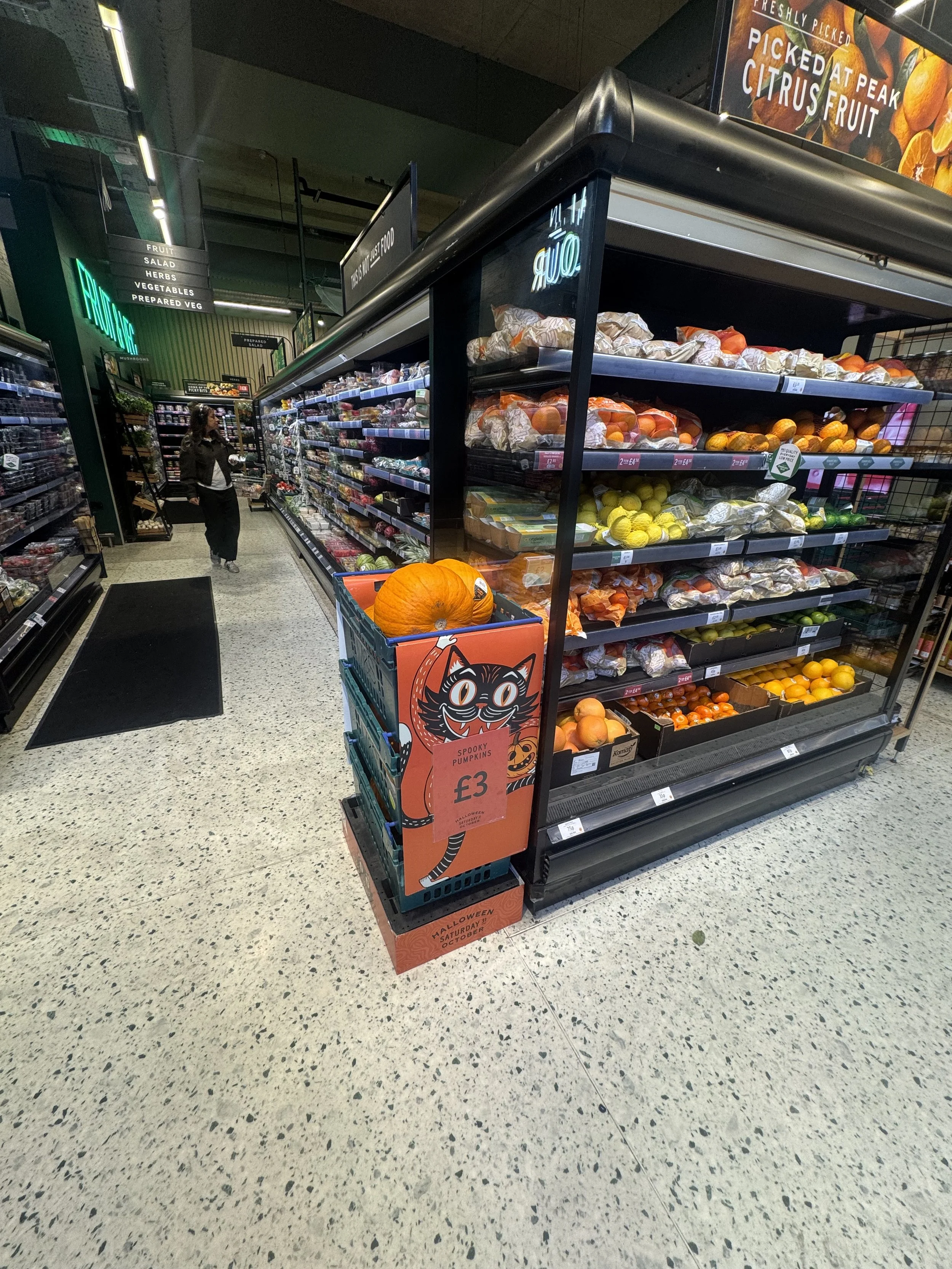
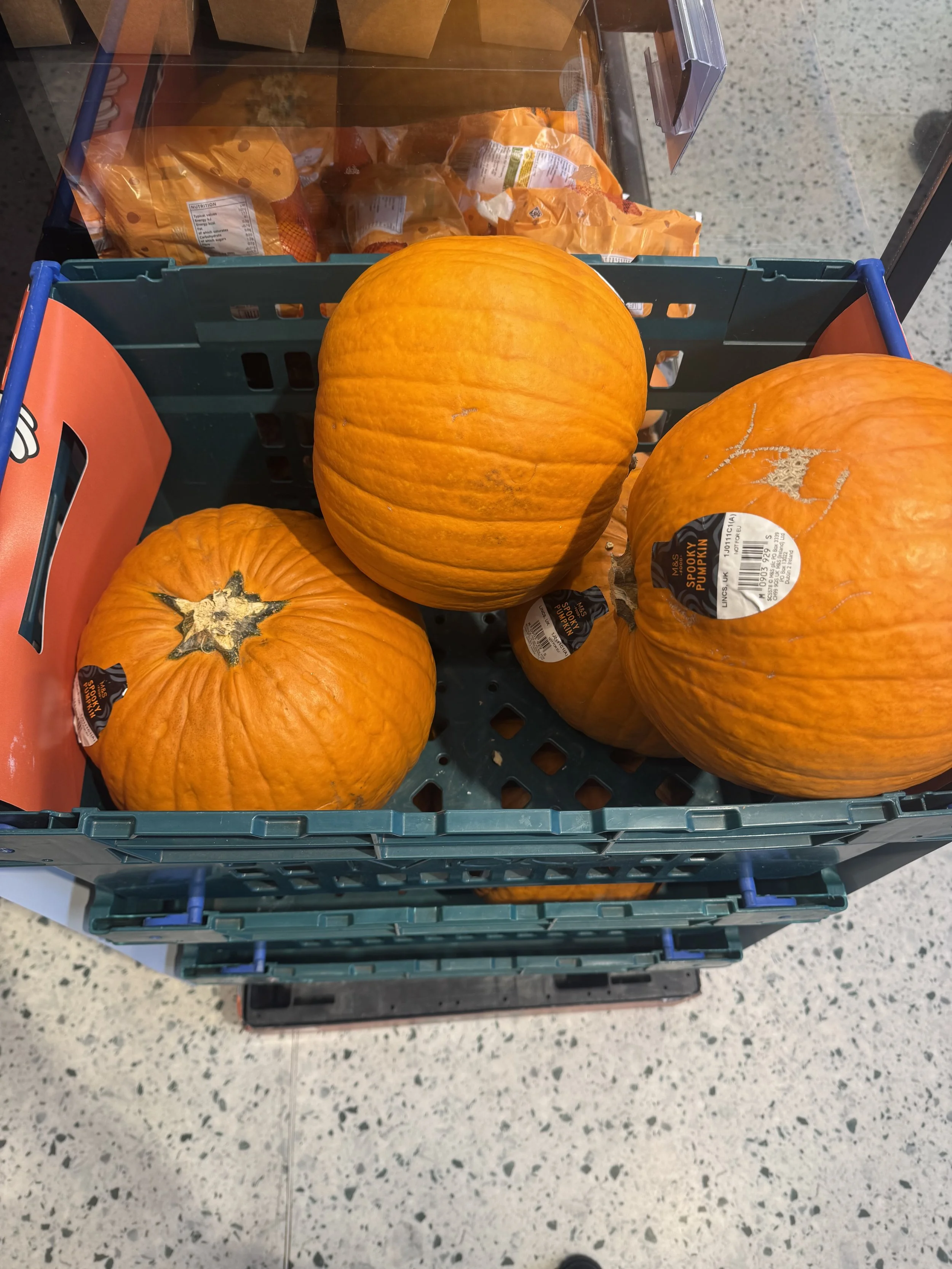
Further checks online showed that Sainsbury’s, Ocado and Morrisons capped carving pumpkin orders at four, six and five respectively. Retailers use quantity limits to protect availability for other customers, although it is unclear whether these particular caps reflect this year’s harvest. On top of the sore display at M&S, I’d also like to point out that this entire article was triggered by a recent trollop through the big Tesco on Brixton’s Acre Lane, where I realised there were no pumpkins of any redeemable size or quality to be found anywhere in the shop.
Sadly, after this summer, I’m not so shocked that the big orange balls are scarcer than normal. 2026 was the hottest summer Britain has had since 1884. Importantly, this warmth coincided with the driest English July since records began in 1836. Through July, England only received 6.5mm of rain, 10% of the long-term average. By 10 August, 71.3% of England was declared officially in drought. I can still smell the dryness and hear the crunch of dead leaves, drained of all moisture, that littered the yellow tundra that was London-sweltering-fields in August.

The Met Office says human-induced climate change made a summer this hot approximately 130 times more likely. In a climate without human greenhouse-gas emissions, its modelling suggests such a summer would occur less than once in 1,000 years; in today's climate, roughly once in nine.
PUMPKIN DEATH
The weather was especially bad for pumpkins, which can only benefit from warmth if there is also water to nourish the vines the fruit grows from. Together, the extreme heat and dryness compounded to create a disastrous harvest cycle. Pumpkins are planted in spring and swell throughout July and August - the key stage that makes pumpkins big, chunky, bright and orange. Typically, they are then harvested in September and October.
The immense summer warmth, however, encouraged maturing early during the key growth stage, while the lack of soil moisture in July and August put strain on the quality of growth itself. Reports indicate that some farmers were left with fruit that had matured well ahead of the Halloween sales window. One Shropshire grower described his pumpkins as ready with almost two months still to go before Halloween. Growers at Llynclys Hall and Pumpkin Pete were left with storage concerns after their pumpkins ripened far too early, and Rookery Farm on the Hampshire-Berkshire border had noticeably smaller fruit. There is little comfort in having pumpkins ready to sell if they cannot last until people want to buy them.
Tiny pumpkins and early harvests have not been the only issue imposed by extreme weather. For many farmers, there have been few or no pumpkins at all. Why? A formative 1999 study found that prolonged high temperatures can increase flower and young-fruit abortion. Another, more recent, 2024 study found that drought can significantly damage female flowers specifically, causing them to abort the fruiting process before even opening. Chris Sadler from East Yorkshire’s Sandy Bottom Farm reported in July that only half of his planted seeds had emerged. Ruffins Farm in Suffolk also took a hard hit, harvesting only 25 pumpkins despite a usual 10,000 - this 99.75% collapse meant they had to cancel their picking.
Irrigation Divide
But hear this: not all farms suffered; some are actually having fantastic harvests. How? Irrigation systems. Despite operating in one of England’s areas hardest hit by dry conditions, Stanhill Farm in Kent says its pumpkins were irrigated throughout the summer and that they therefore have ‘plenty of pumpkins ready to pick’. Broadditch Farm, also in Kent and facing the same regional weather issues, however, only harvested 1,500 pumpkins this year despite normally producing 20,000. They credit this decline directly to a lack of irrigation and the exceptionally dry and hot conditions. Stanhill’s pumpkin picking continues; Broadditch’s has been cancelled.
The contrast repeats elsewhere. At Frog’s Farm in Suffolk, Freddy Vaudrey credited a reservoir storing surplus winter water with helping him produce 50,000 pumpkins through the summer’s heatwaves. Elsewhere in the county, Ruffins Farm’s Andrew King reported about 25 pumpkins and cancelled picking. A reservoir was ‘no option at all’ - too expensive for his small farm and the limited water available had to go to his sheep.
Investing in measures to protect crops from exposure presents its own set of dilemmas - particularly affordability ones. At Pumpkin Pete’s in Herefordshire, Ed Godsall was broadly satisfied with his unirrigated crop despite smaller fruit and some losses. He was considering a reservoir, but questioned whether ‘the crops [pumpkins]... [are worth] enough to put irrigation in in the first place?’. Worth noting is that the question is not always whether growers can afford irrigation, but whether the crop would earn enough to justify its cost. For Eleanor Gilbert at Rookery Farm on the Hampshire–Berkshire border, the financial barrier was already clear. She estimated she had lost half her pumpkin crop after spending £6,000 on seed alone. She said she could not afford irrigation, and obtaining her own water supply would cost more than £20,000. Struggling to break even on this year’s harvest leaves little room to finance protection for the next. This distinction leads to the same question, nonetheless: who gets to grow what?
Advising growers to prepare for extreme temperature does not magically imbue them with the equipment to generate a reliable supply of water. Ahead of the 2026 growing season, the Environment Agency had urged farmers to secure sufficient water supplies and refill their irrigation reservoirs. Yet, as drought intensified, it also restricted the water some growers could take from rivers: by mid-August, 288 spray-irrigation licences in parts of East Anglia faced a 50% reduction in abstraction. These restrictions protected depleted rivers, but exposed the limits of irrigation as an answer to drought. In cases where drought ravaged local rivers, even having the equipment does not guarantee access to the water it needs. What does, then, reliable protection cost, and how widely available is it?
Capital! The answer is capital, as it so often is. The government’s previous Water Management Grant in England offered funding for reservoirs, pumps, underground distribution mains, irrigation controls, trickle systems, sprinklers and soil-moisture monitoring equipment. Grants ranged from £35,000 to £500,000, but covered at most only 40% of eligible project costs. Farmers had to finance the remaining 60% or more through private sources, such as savings or borrowing. A £35,000 grant covering 40% of an £87,500 project would still leave £52,500 to find.
The government’s response recognises the need for investment and changes to the rules. In August, responding to the drought, Defra announced up to £15 million for on-farm reservoirs and measures intended to make them easier to build. The Environment Agency has also acknowledged that difficulties obtaining long-duration abstraction licences had held back investment in farm storage reservoirs, saying it has changed its assessment process to support longer-term investment.
The UK Irrigation Association describes farm reservoirs as moving “from optional to essential”. Capturing water in winter can reduce growers’ dependence on taking it from rivers during summer, when supplies are under greatest pressure. But a reservoir still needs filling. Where a farm sits matters because it determines the rivers and groundwater available locally, the demands already placed on them and the opportunities to capture water when it is plentiful. The Environment Agency’s national framework says that, at low river flows, nearly all catchments in eastern and south-eastern England cannot support new abstractions. The irrigation divide therefore has a geographical dimension, too. Farmers’ ability to protect their crops depends partly on where they farm, as well as what they can afford.
Helping growers adapt will mean making water storage and efficient irrigation affordable, improving access to sustainable supplies and protecting the rivers those supplies depend on. Otherwise, hotter, drier summers - like the one we were just tormented by - risk widening the gap between farms able to protect their crops and those left exposed.
There is a wider risk here: as hotter, drier summers make reliable water supplies more valuable, growers who can afford protection may be better placed to survive poor seasons and supply customers when others cannot. This raises a question about who gets to keep farming as adaptation becomes more expensive. For one grower, a reservoir might be a worthwhile investment; for another, it might be unaffordable, or, perhaps, cost more than the crop could ever justify.
Who, then, should bear that cost? If taxpayers are helping to fund adaptation, it is fair to ask what their money should protect. My Halloween plans alone are hardly grounds for a publicly funded reservoir. Yet a farm’s water supply may support more than its October pumpkin patch, and the value of protecting it cannot be judged solely by what we carve faces into. The challenge is deciding how to support growers while protecting the rivers they depend on, without leaving those with the least money permanently exposed. I can make do with a pencil-holder-sized pumpkin. Gilbert is already wondering whether she can afford another pumpkin harvest at all.